+1 (951) 297 8375
Fax: +1 (951) 602
8264
contact@karmadocs.com
Mon - Fri: 9:00 AM - 5:00 PM
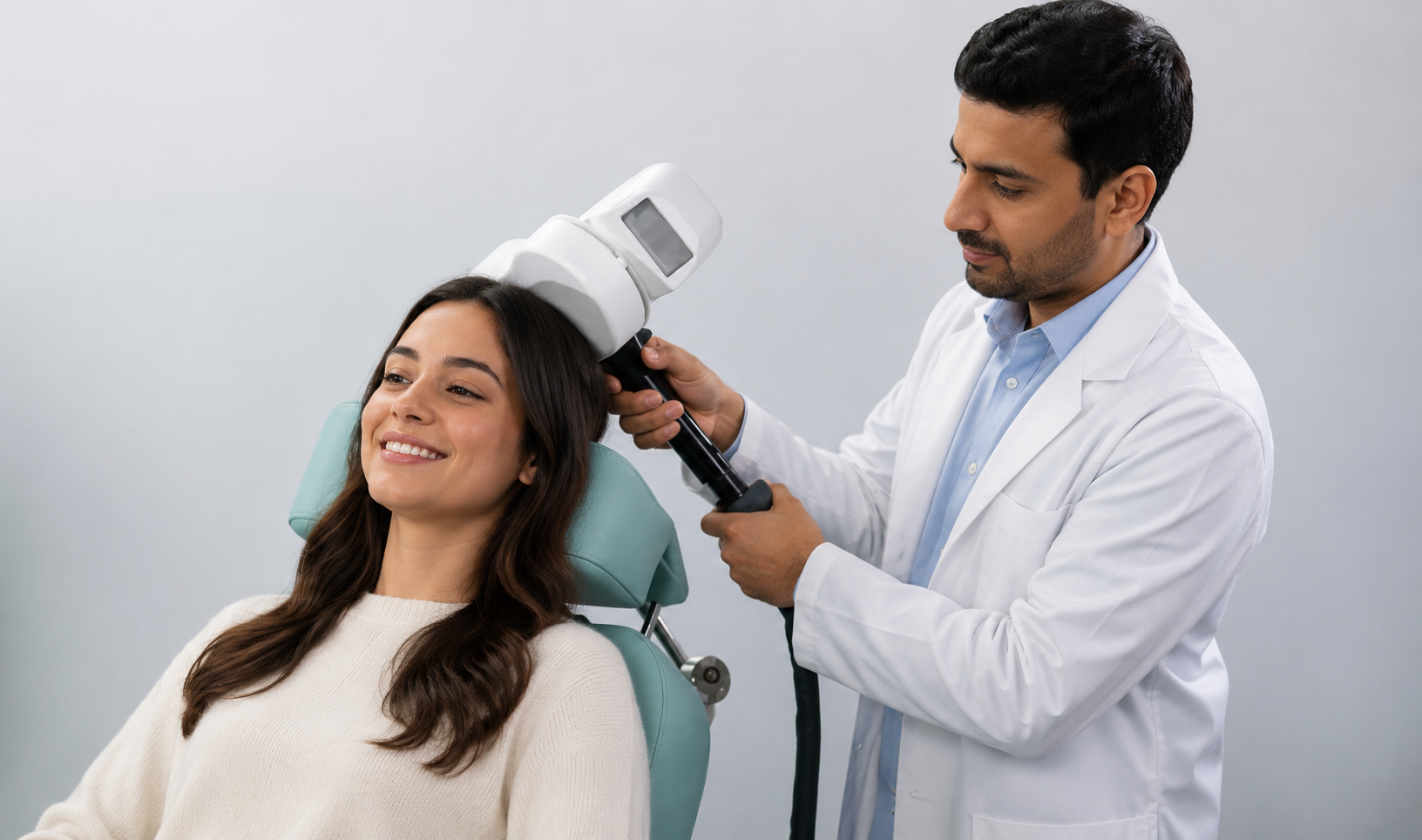
If you’re considering Transcranial Magnetic Stimulation (TMS) for depression, anxiety, OCD, or PTSD, you’ve probably already asked your search engine some version of this question: how many sessions until I actually feel better? It’s a fair question, and one of the most common ones we hear from patients walking into our offices across Palm Springs, Rancho Mirage, Palm Desert, and the greater Coachella Valley.
The honest answer is: it depends. But “it depends” isn’t very satisfying when you’re the one living with symptoms that haven’t budged despite therapy, medication, or both. So let’s break down what the research actually shows, what a typical TMS treatment plan looks like, and — just as importantly — what factors push that number up or down for any individual patient.
At Karma Doctors & Associates, led by double board-certified psychiatrist Dr. Keerthy Sunder, we take this a step further by using Personalized Repetitive TMS (PrTMS) guided by qEEG brain mapping, rather than a one-size-fits-all protocol. That distinction matters a lot when it comes to session count, and we’ll explain exactly why below.
Transcranial Magnetic Stimulation uses focused magnetic pulses, similar in strength to an MRI machine, to stimulate specific regions of the brain associated with mood regulation — most commonly the dorsolateral prefrontal cortex (DLPFC). This area tends to be underactive in people with depression. The pulses encourage the brain to fire and form new connections, a process called neuroplasticity, which over time can help lift depressive symptoms, ease anxiety, or reduce OCD-related compulsions.
TMS is FDA-cleared, non-invasive, and doesn’t require anesthesia or sedation. You sit in a chair, remain fully awake, and can drive yourself home afterward. The first TMS device received FDA clearance for treatment-resistant depression in 2008, and clearance has since expanded to cover conditions including OCD and anxious depression, with newer accelerated protocols continuing to emerge.
Most conventional TMS protocols follow a fairly predictable rhythm:
That adds up to somewhere between 20 and 36 sessions for a full initial course in most standard clinics. This is a general clinical timeline, not a guarantee — some patients notice meaningful shifts earlier, and others need the full course (or a bit longer) before they feel a difference.
It’s worth repeating: these numbers describe averages across large patient populations in clinical trials. Your personal number of sessions is something your psychiatrist determines based on your specific symptoms, history, and how you’re responding along the way — not a fixed formula.
Most TMS clinics apply the same frequency, intensity, and target location to every patient with a given diagnosis. Karma Doctors & Associates takes a different route: Personalized Repetitive TMS (PrTMS), developed with the guidance of qEEG (quantitative electroencephalogram) brain mapping.
Here’s what that means practically:
Why does this matter for your session count? Because a personalized, data-guided protocol is designed to more precisely match the stimulation to what your brain needs, which can influence both how quickly you notice changes and how many total sessions are recommended. Some patients on personalized protocols report meaningful shifts earlier than they would on a generic protocol; others with more complex, co-occurring conditions (like combined PTSD and traumatic brain injury) may need a longer, more carefully monitored course. The point of qEEG-guided PrTMS isn’t to promise a shorter treatment — it’s to make sure the treatment you’re getting is actually suited to your brain.
Several factors influence how many TMS sessions a person needs. None of these is something you can diagnose yourself — they’re exactly what a psychiatric evaluation is designed to sort out — but understanding them helps set realistic expectations.
Your diagnosis and its severity. Major depressive disorder, treatment-resistant depression, anxious depression, OCD, and PTSD each come with different evidence-based protocols and different expected timelines. Severe, long-standing symptoms sometimes take longer to shift than milder or more recent-onset symptoms.
Your treatment history. Patients who have already tried and failed multiple antidepressants (the technical definition of “treatment-resistant”) make up the majority of TMS candidates, and this history is factored into the protocol design.
Individual biological response. Two patients with an identical diagnosis can respond to the same stimulation completely differently. This is precisely the variability that qEEG-guided personalization is designed to account for.
Protocol type. Standard rTMS, deep TMS, and accelerated/theta-burst protocols all have different session lengths and total course lengths. Newer accelerated protocols compress a course that once took six weeks into a much shorter window by delivering multiple sessions per day — though not every patient is a candidate for accelerated dosing.
Co-occurring conditions. Anxiety, PTSD, or a history of traumatic brain injury alongside depression can shift a treatment plan, sometimes extending the initial course or adjusting the specific targets used.
Consistency and attendance. TMS works cumulatively — missed sessions can slow progress, which is one reason the standard protocol is built around daily, consecutive treatment.
Research and real-world clinical experience both point to a similar pattern: most people don’t feel a dramatic shift after session one. Early sessions are more about the brain beginning to respond at a cellular level than about a felt, obvious change. Many patients report the first noticeable improvements — better sleep, slightly more motivation, a little less mental fog — somewhere around the second or third week, often coinciding with roughly the 10th session or so. Full benefit typically continues to build through the remainder of the course.
That said, timelines vary widely, and some patients on faster, accelerated protocols report changes within the first several days.
It’s worth grounding expectations in real data rather than marketing claims. Published research on standard rTMS protocols has generally found response rates (meaning a 50% or greater reduction in symptoms) in a broad range depending on the study population, with treatment-resistant populations in real-world clinical settings often showing higher response rates than the original placebo-controlled trials. Full remission — meaning symptoms drop low enough that a person no longer meets criteria for depression — has been reported in roughly 30–35% of patients in several published analyses, with real-world registries and newer protocols sometimes reporting higher figures. Depression severity is one of the biggest predictors: patients starting with mild-to-moderate symptoms tend to have meaningfully higher remission rates than those starting with severe, long-standing symptoms.
Some newer accelerated and bilateral protocols have reported even higher response rates in preliminary studies, though larger, longer-term studies are still needed before those numbers can be considered fully established. We share these figures not to promise a specific outcome for you personally — no ethical psychiatric practice can do that — but so you can walk into a consultation with realistic, evidence-based expectations rather than either false hope or unnecessary skepticism.
“One or two sessions should be enough.” TMS works by gradually encouraging neuroplastic change. It’s not a single-dose treatment, and expecting results after one or two visits sets up disappointment. The evidence base is built around a full course, not a handful of sessions.
“TMS is basically the same as ECT, just a shorter version.” Electroconvulsive therapy (ECT) requires anesthesia and induces a controlled seizure; TMS does neither. They’re both forms of brain stimulation, but the mechanism, sedation requirements, side effect profile, and treatment course are quite different.
“If it’s not working by week two, it’s a failure.” Response often builds gradually, and per-protocol data shows many patients don’t reach their turning point until well into the second or third week of daily treatment.
“Everyone follows the exact same number of sessions.” As covered above, session count is individualized — especially in a PrTMS, qEEG-guided model, where the protocol is adjusted to the person, not the calendar.
You don’t need a formal diagnosis in hand to start the conversation. If you’ve tried one or more antidepressants without meaningful relief, if therapy alone hasn’t moved the needle, or if you’re dealing with persistent depression, anxiety, OCD, or PTSD symptoms that are affecting your daily life, a comprehensive psychiatric evaluation is the appropriate next step. That evaluation — which at Karma Doctors & Associates typically includes a review of your history, symptoms, and goals, and may include qEEG brain mapping — is what actually determines whether TMS is appropriate for you and what your personalized session plan might look like.
Karma Doctors & Associates provides Personalized Repetitive TMS (PrTMS), qEEG brain mapping, psychiatric evaluations, and integrative medication management to patients throughout Palm Springs, Rancho Mirage, Palm Desert, Twentynine Palms, and the wider Coachella Valley. Led by Dr. Keerthy Sunder — a double board-certified psychiatrist with more than two decades of clinical experience — our team combines evidence-based neuromodulation with a whole-person approach to mental health care, treating depression, anxiety, OCD, and PTSD with the same data-driven attention we bring to every qEEG-guided treatment plan.
Every brain is different, which is exactly why we don’t hand every patient the same generic protocol. If you’re wondering how many TMS sessions your situation might call for, the most reliable way to find out is a comprehensive psychiatric evaluation with our team. We’ll walk you through what qEEG-guided PrTMS looks like for your specific symptoms, answer your questions about what sessions actually feel like, and help you understand realistic timelines before you commit to anything. If you’re searching for TMS therapy in Palm Springs or looking for one of the best psychiatrists in the Coachella Valley to guide you through treatment-resistant depression, reach out to Karma Doctors & Associates to schedule your evaluation.
Most standard courses involve daily sessions, five days a week, for about 4 to 6 weeks — typically 20 to 36 sessions total — followed by an optional taper and occasional maintenance sessions. Your personalized plan may differ based on your diagnosis and response.
Many patients report early improvements — like better sleep or slightly more motivation — around the second or third week of treatment, though some notice changes sooner and others need the full course before a difference is clear.
No. Session count depends on diagnosis, severity, treatment history, co-occurring conditions, and how your brain responds. This is exactly why Karma Doctors uses qEEG-guided PrTMS instead of a fixed, generic protocol.
Your psychiatrist monitors your progress throughout treatment and can adjust the protocol — including frequency, targeting, or intensity — rather than simply continuing an unchanged plan. This is part of why regular check-ins matter during your course.
Yes. Standard TMS applies a generic protocol based on diagnosis alone. PrTMS uses qEEG brain mapping to tailor the frequency and targeting of your sessions to your individual brain activity, with the option to reassess and adjust as treatment progresses.
Some patients benefit from periodic maintenance or “booster” sessions to help sustain results, particularly if symptoms begin to return. Whether this applies to you is something your psychiatrist will discuss based on your response.
Most major insurance plans cover TMS for eligible diagnoses, typically after documentation of prior treatment attempts. Coverage details vary by plan, so it’s best to verify your specific benefits directly with our office.
Karma Doctors & Associates provides PrTMS and qEEG-guided psychiatric care across Palm Springs, Rancho Mirage, Palm Desert, Twentynine Palms, and the greater Coachella Valley.