+1 (951) 297 8375
Fax: +1 (951) 602
8264
contact@karmadocs.com
Mon - Fri: 9:00 AM - 5:00 PM
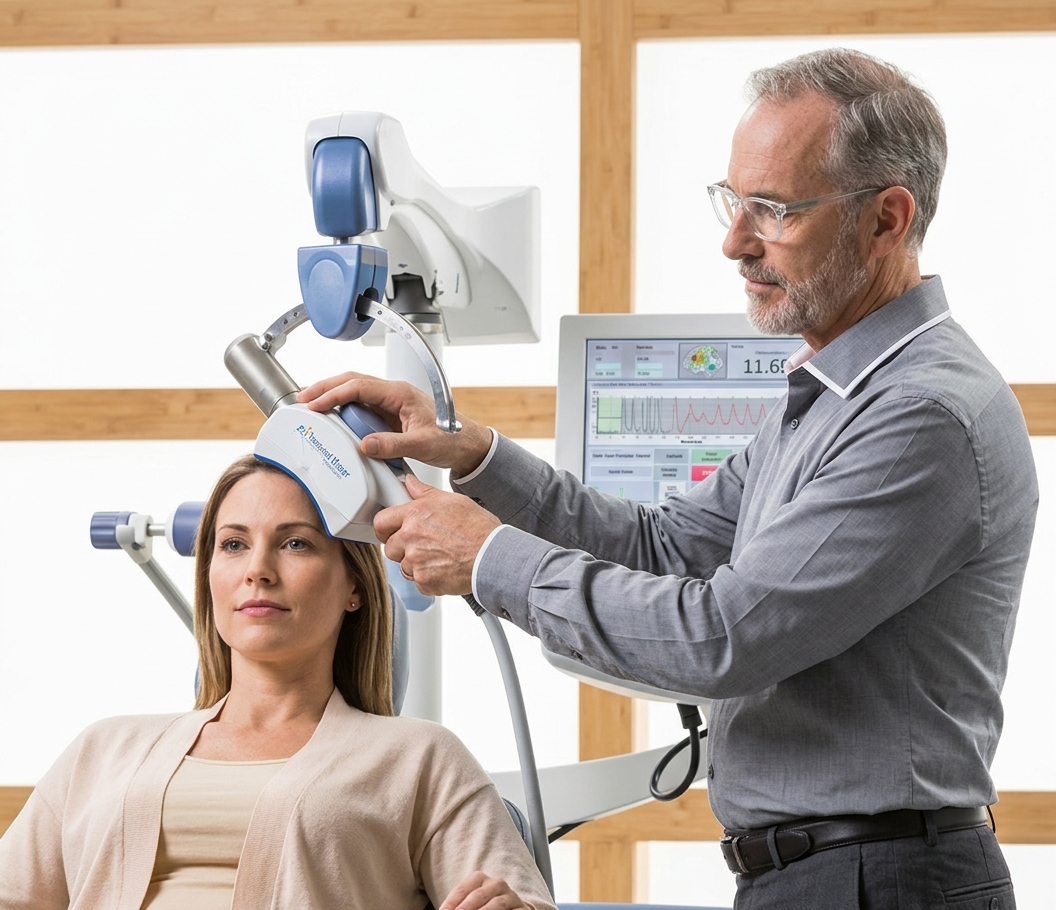
Mental health treatment has evolved rapidly—but many patients still struggle to find relief through medications or therapy alone. That’s where Transcranial Magnetic Stimulation (TMS) comes in.
TMS treatments are a non-invasive, FDA-approved therapy designed to stimulate specific areas of the brain involved in mood regulation using magnetic pulses.
At Karma Doctors & Associates, TMS is offered as an advanced solution for individuals dealing with treatment-resistant depression, anxiety, and other psychiatric conditions.
TMS (Transcranial Magnetic Stimulation) is a brain stimulation therapy that uses focused magnetic fields to activate underperforming neurons in the brain—especially in the prefrontal cortex, which is often less active in people with depression.
Unlike medications that travel through your bloodstream, TMS works directly at the source—the brain circuits responsible for mood.
TMS is based on the principle of electromagnetic induction—the same concept used in MRI machines.
Over time, this repeated stimulation leads to neuroplasticity, meaning your brain rewires itself for healthier functioning.
Understanding the process reduces anxiety and helps patients feel prepared.
Your provider identifies the exact area of the brain to target.
You sit in a comfortable chair while a magnetic coil is positioned on your scalp.
TMS is primarily used in psychiatry but is expanding into neurology.
TMS stands out because it solves many problems associated with traditional treatments.
| Feature | TMS Therapy | Antidepressants | Talk Therapy |
|---|---|---|---|
| Target Area | Brain circuits | Whole body | Behavioral patterns |
| Side Effects | Minimal | Moderate–High | None |
| Speed | 2–4 weeks | 4–8 weeks | Varies |
| Best For | Resistant cases | Mild–Moderate | Emotional coping |
TMS is often used when other treatments fail or are not tolerated.
Clinical outcomes are one of the biggest reasons for TMS adoption.
Results vary based on:
Many patients experience relief for 6 months to over a year.
TMS is not just a temporary fix—it can create lasting neurological change.
TMS is considered extremely safe, especially compared to medications.
Most side effects of TMS therapy decrease after the first few sessions.
You may be an ideal candidate if:
TMS may not be suitable if you have:
A full evaluation at Karma Docs ensures safety and suitability.
The cost of TMS varies depending on provider and treatment plan.
Karma Docs assists patients with insurance verification and approvals, making treatment more accessible.
Karma Doctors & Associates stands out for its patient-centered and evidence-based approach.
Their goal is not just symptom relief—but long-term recovery and improved quality of life.
A light tapping sensation on the scalp with clicking sounds.
Results can last long-term, but maintenance may be needed.
It may not “cure” it permanently but can significantly reduce or eliminate symptoms.
Typically within 2–4 weeks.
Yes, you can continue your daily routine.
TMS is less invasive and has fewer side effects than Electroconvulsive Therapy.
TMS treatments are revolutionizing mental health care by offering a safe, effective, and drug-free alternative for people who haven’t found success with traditional methods.
With strong clinical backing and increasing accessibility, TMS is becoming a first-choice advanced therapy for depression and beyond.
If you’re struggling with depression, anxiety, or other mental health conditions and haven’t found relief, our TMS therapy in Palm Springs could be the solution you’ve been searching for.
Contact us to book your consultation with Karma Doctors & Associates and take the first step toward lasting mental wellness.